Imagine a computer program that doesn't just answer your questions, but actually completes your "to-do" list for you. From booking flights to managing your emails, AI Agents are the next big leap in technology. In this article, we’ll explain exactly what they are and how they work.
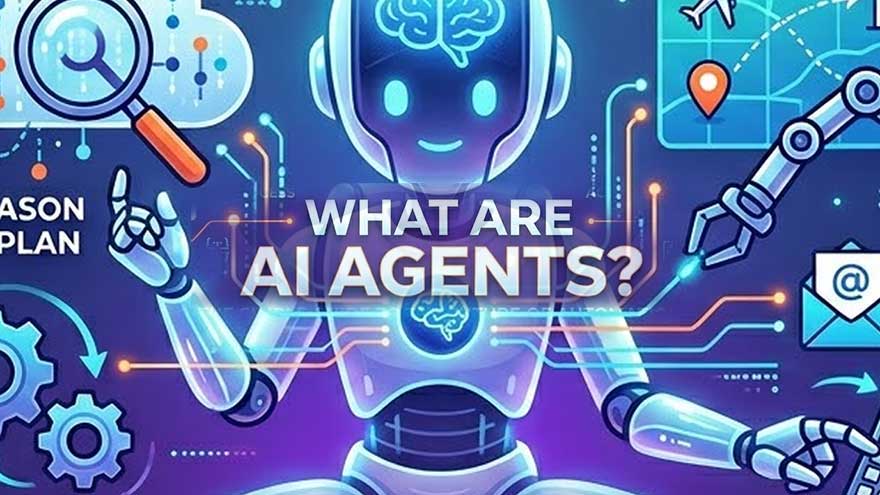
Welcome to the future of the internet! If you’ve been following tech news lately, you’ve probably heard the term "AI Agent" being tossed around. It’s the biggest buzzword since "ChatGPT," but it’s actually something much more powerful.
If a chatbot is like a talking book, an AI Agent is like a digital employee.
In this guide, we’ll break down exactly what these agents are, how they work, and why they are changing the way we live and work—all.
To understand an AI Agent, let’s first look at what we already know: AI Chatbots (like the basic version of ChatGPT).
Think of an AI Agent as a very smart, very fast remote intern.
An AI Agent isn't just a piece of code that follows a straight line. It follows a "loop" of thinking that makes it feel almost human. This is often called the Agentic Loop.
One of the most amazing things about an agent is its ability to use "Tools." Just like a human mechanic uses a wrench to fix a car, an AI Agent uses APIs (digital bridges) to interact with other software.
By 2026, AI agents are moving out of labs and into our daily lives. Here are a few ways they are being used right now:
1. The Personal Travel Agent
Imagine an agent that knows you hate morning flights and prefer aisle seats. It monitors flight prices for weeks and, the moment your favorite airline drops its price, it notifies you or buys the ticket instantly.
2. The Customer Support "Concierge"
Old chatbots used to say, "I don't understand, let me connect you to a human." New Support Agents can actually look up your specific order, realize it was delayed by a storm, issue you a 20% refund, and email you a tracking link—all without a human ever touching it.
3. The Coding Assistant
For the tech-savvy, agents like Claude Code or GitHub Copilot Agents don't just suggest a line of code; they can build entire features, test them for bugs, and fix the errors they find until the software works perfectly.
You might think, "Wait, my dishwasher is an 'agent' because it washes dishes automatically!" Not quite.
Traditional Automation is like a train on tracks. It can only go where the tracks are laid. If a cow sits on the tracks, the train just hits it or stops. It can’t "decide" to go around.
AI Agents are like self-driving cars. They have a destination (the goal), but they navigate the traffic, pedestrians, and road closures (the obstacles) on their own using logic.
| Feature | Traditional Automation | AI Agents |
| Flexibility | Rigid (follows "If-This-Then-That" rules) | Flexible (adapts to new information) |
| Problem Solving | Breaks if something unexpected happens | Tries a different way to solve the problem |
| Tools | Usually uses one system | Can use web browsers, APIs, and apps |
To make it easy for your readers, you can categorize them into these four groups:
In the past, to make a computer do something, you had to be a programmer. You had to write every single "If/Then" rule.
Today, because of AI Agents, you can use Natural Language (plain English). You don't need to know how to code; you just need to know how to give clear instructions. This is "democratizing" technology—giving everyone the power of a software developer.
Whenever AI gets "autonomous" (meaning it can act on its own), people naturally worry. The two biggest concerns are:
AI Agents are the next evolution of technology. We are moving away from a world where we use computers to a world where we collaborate with them. Instead of you spending hours organizing data in Excel, you will simply tell your Agent: "Find the trends in this data and make a PowerPoint for the meeting at 4 PM."
And just like that, you’re the manager, and the AI is your most productive employee.